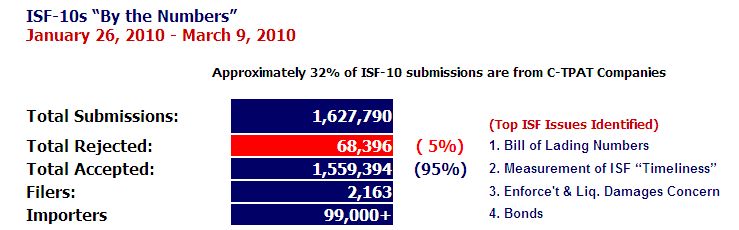
The
Import Security Filing Subcommittee
of the Advisory Committee on Commercial
Operations of U.S. Customs and Border
Protection (COAC) recommended at the
Aug. 4 COAC meeting in Detroit that
CBP provide the following benefits
to importers that are highly compliant
with ISF requirements.
*
For importers who are certified Customs-Trade
Partnership Against
Terrorism members, high compliance
with ISF requirements should be deemed
a best practice and considered with
respect to elevating the importer’s
C-TPAT status to the Tier 3 level.
*
In cases where stratified compliance
exams are undertaken by CBP (where
multiple shipments are under one bill
of lading) and the importer is a C-TPAT
member, CBP should allow sealed containers
not being examined to not only move
to destination but to be released
by CBP.
*
CBP should also consider the option
of releasing for distribution other
bills of lading on the same entry
(where the importer is a C-TPAT member).
As with the above recommendation,
the released containers in question
would be those not designated for
exam. To address potential CBP concerns,
this benefit would not include containers
stuffed by the same party that stuffed
the container(s) designated for exam.
*
For small and medium-size importers
that are highly compliant, CBP should
consider a streamlined process for
application to C-TPAT.
*
In the case of unified ISF filings,
conditional release in the system
at time of vessel departure should
be provided.
*
Consideration of mitigation for other
penalties (outside those associated
with ISF compliance) should be given
for highly compliant importers.
*
For continuous, highly compliant importers,
there may be a situation where CBP
identifies a problem that is very
low frequency (e.g., one out of a
thousand). CBP should take this into
consideration with respect to penalties.
The
subcommittee also included information
on the collateral benefits of ISF
that have been identified by highly
compliant importers. One such benefit
is that importers have better visibility
into their global supply chains since
they now have a CBP process at origin.
Companies can identify non-standard
shipments earlier in the process,
allowing them more time to address
the issue prior to arrival and potential
delay. In addition, because importers
provide data earlier, there are fewer
delays at destination. Working through
the ISF requirements has also highlighted
that import compliance teams need
to be folded into the procurement
process earlier. Finally, importers
have become more engaged with parties
not typically communicated with in
the past, which provides more visibility
and mprovement in data availability
and accuracy.


 最近の話題(日付順)